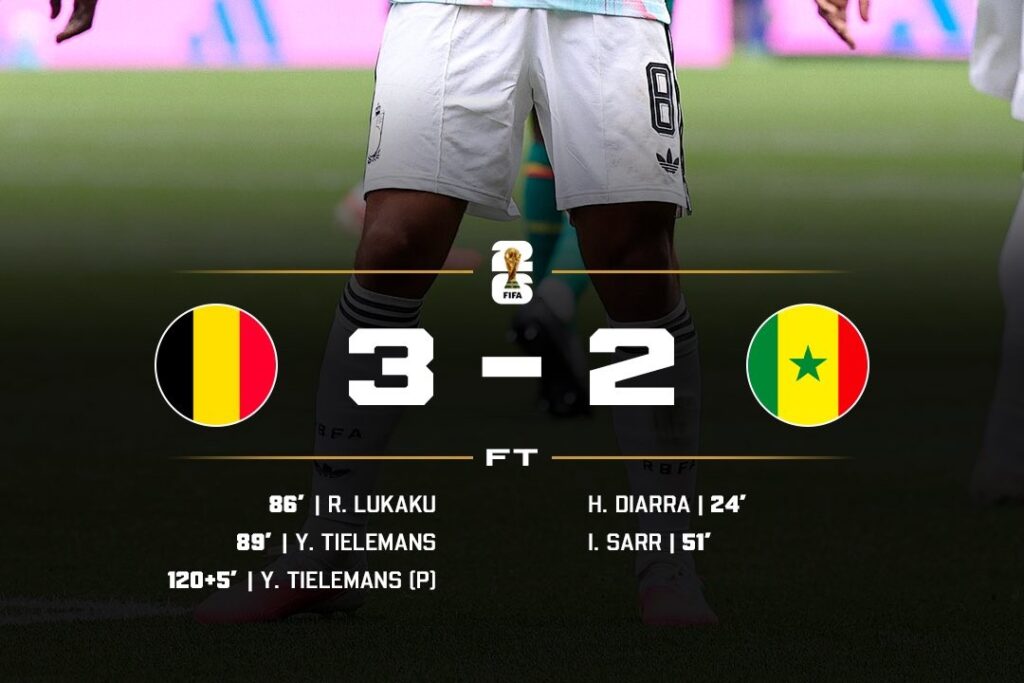
For nearly an hour, Senegal looked destined to write one of the biggest stories of the FIFA World Cup. They were fearless, organized, and clinical, racing into a deserved 2-0 lead against Belgium. The African giants had frustrated one of Europe’s strongest footballing nations and seemed to have one foot in the next round.
Then football reminded everyone why a match lasts 90 minutes.
Belgium produced an astonishing comeback, scoring three unanswered goals to complete a dramatic 3-2 victory and break Senegalese hearts. It was one of the tournament’s most memorable comebacks so far and another painful chapter for African football, which has struggled to convert promising performances into famous victories.
Senegal Had the Perfect Start
From the opening whistle, Senegal showed courage. They didn’t sit back and simply admire Belgium’s reputation. Instead, they pressed aggressively, attacked with confidence, and exposed weaknesses in the Belgian defense.
The reward came in the form of two well-earned goals that stunned both Belgium and neutral fans watching around the world.
At 2-0, Senegal looked comfortable. Their confidence was growing, while Belgium appeared rattled and short of ideas.
For a team carrying the hopes of an entire continent, everything was going according to plan.
The Turning Point: Fear Replaced Belief
Football often punishes teams that stop playing to win and instead begin playing not to lose.
That is exactly what appeared to happen.
Rather than continuing to press Belgium and keep possession, Senegal gradually retreated deeper into their own half. The attacking confidence that had earned them a two-goal advantage slowly disappeared.
Instead of asking Belgium more questions, they invited them forward.
Against elite European teams, that approach can be extremely dangerous.
Belgium suddenly had more time on the ball, more territory, and more opportunities to build sustained pressure. Every minute that passed increased the belief inside the Belgian camp.
One Mistake Changed Everything
When a team spends long periods defending, concentration naturally becomes more difficult to maintain. Eventually, one defensive lapse was all Belgium needed.
That single mistake led to Belgium’s opening goal, instantly changing the momentum of the match. The score became 2-1, but psychologically it felt much bigger.
Belgium suddenly believed a comeback was possible.
Senegal, on the other hand, began to look nervous.
Football is often decided by momentum, and once Belgium gained it, the game completely changed.
Belgium Showed Why Experience Matters
Great teams rarely panic.
Belgium’s experienced players remained patient despite trailing by two goals. Rather than forcing attacks, they continued moving the ball, waiting for spaces to appear.
Once the first goal arrived, Belgium played with renewed confidence and intensity.
Their passing became sharper.
Their movement became quicker.
Their belief became stronger.
Eventually, the equalizer came, followed by the winning goal to complete one of the biggest comebacks of the tournament.
It was a reminder that elite teams are never beaten until the final whistle.
A Frustrating Pattern for African Teams
Unfortunately, Senegal’s defeat also reflects a wider issue that has affected several African teams in this World Cup.
Many have shown they possess enough talent, athleticism, and tactical discipline to compete with the world’s best. In several matches, African nations have even looked like the better side for long periods.
The problem has often been managing games after taking the lead.
Instead of maintaining their attacking identity, some teams have become overly defensive too early, allowing stronger opponents to dominate possession and build pressure.
Football history has shown that continuously inviting attacks eventually increases the chances of conceding.
No defense can absorb endless pressure without mistakes.
Respect Bigger Teams—But Don’t Fear Them
Perhaps the biggest lesson from Senegal’s defeat is psychological.
Too often, African teams enter matches against football giants with unnecessary fear or excessive caution.
Respecting a strong opponent is sensible.
Fearing them is different.
Fear changes decision-making.
Fear encourages players to defend deeper than necessary.
Fear leads teams to abandon the style that made them successful in the first place.
Ironically, Senegal proved during the opening stages that Belgium could be hurt. Their first-half performance showed they were capable of matching one of Europe’s biggest football nations.
If anything, those opening 60 minutes should give future African teams confidence rather than doubt.
The quality exists.
The belief simply has to last for the entire match.
There Is Still Plenty to Be Proud Of
Despite the heartbreaking result, Senegal deserve enormous credit.
They pushed Belgium further than many expected.
They demonstrated excellent organization, courage, and attacking quality against one of the tournament favorites.
For long stretches, they were the better team.
Football can be cruel, and sometimes a few moments decide everything.
This defeat should not erase the positives from Senegal’s performance. Instead, it should serve as a valuable lesson about game management, mentality, and maintaining belief against elite opposition.
African football continues to produce talented players capable of competing on the biggest stage. The next step is learning how to turn dominant performances into famous victories.
Senegal may have left the tournament with disappointment, but they also left with respect.
Their performance proved once again that African football belongs among the world’s best.
The only missing ingredient is the confidence to keep believing until the very last whistle.